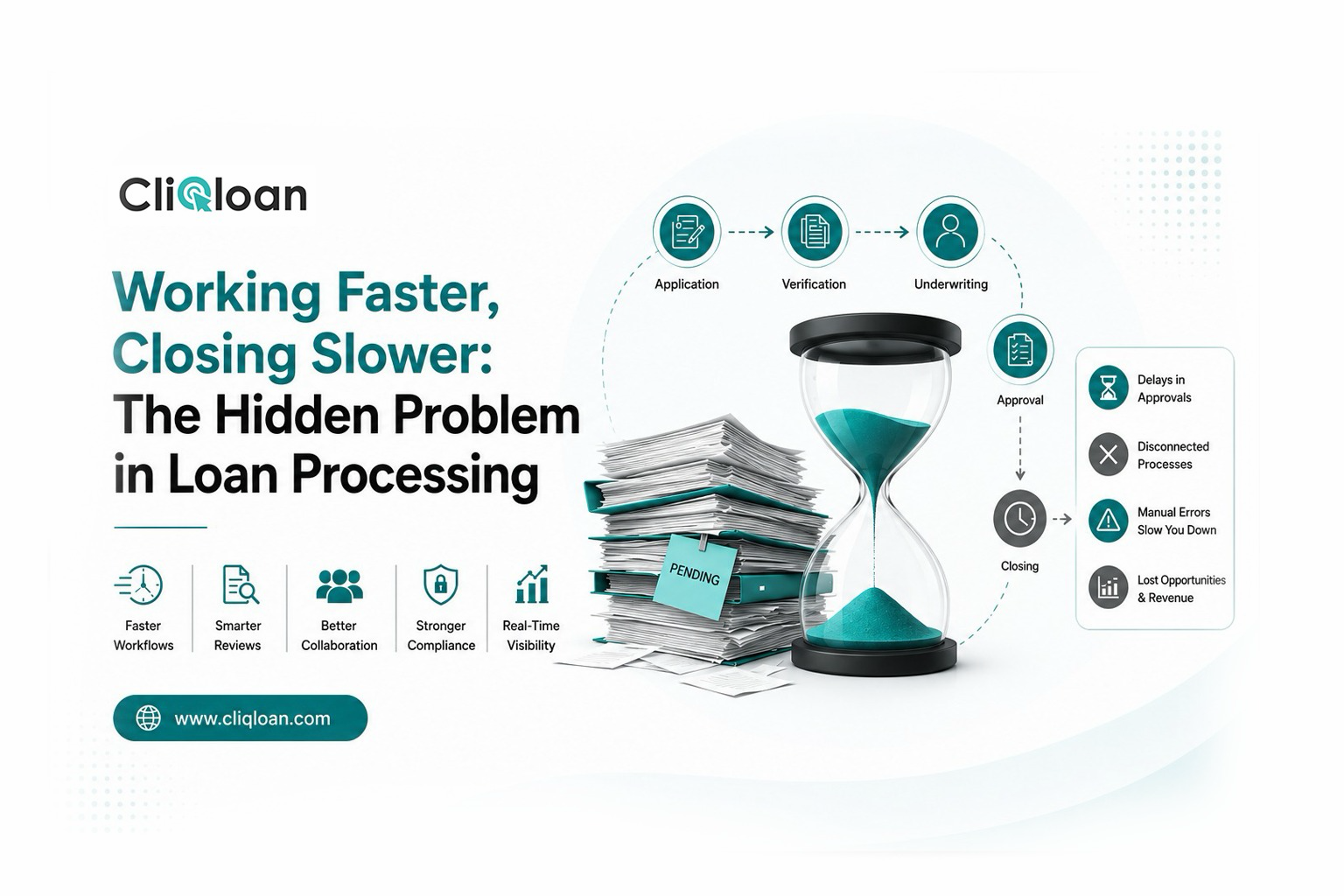
All of us have faced this issue when the results don't reflect the efforts you are putting in. Honestly, we all know how frustrating it is. We all face this gap but are not able to find the reason for it. In today's mortgage and FinTech industries, operational efficiency is no longer a competitive advantage but a baseline expectation. Borrowers demand faster approvals, seamless digital experiences, and complete transparency throughout the lending journey. Simultaneously, lending teams are under increasing pressure to process higher volumes of applications with greater accuracy and speed.
Despite these advancements, many organizations go through a hard challenge, i.e., loan processing timelines remain slow, even as teams work faster than ever.
This shows a major issue within modern lending operations. The challenge is not workforce productivity, but it is workflow inefficiency and system fragmentation. Until this is addressed, these hidden issues will continue to impact performance, client satisfaction, and revenue growth.
The Productivity Paradox in Modern Lending
On paper, everything looks modern and efficient. But in reality, many systems still don’t work together the way they should. Many financial institutions have already invested in technologies such as a mortgage loan origination system, mortgage CRM software, or a digital mortgage platform. While these tools are designed to enhance operational efficiency, their impact is often limited by incomplete integration and reliance on legacy processes.
Organizations frequently operate in environments where:
Systems function in isolation rather than as a unified ecosystem
Automation is applied selectively rather than holistically.
Data is duplicated across multiple platforms.
Manual interventions remain embedded in critical workflows.
As a result, individual tasks may be completed more quickly, but the end-to-end loan lifecycle remains inefficient.
Fragmented Workflows as a Systemic Constraint
There is a complex flow of people and process behind every loan. Delays become unavoidable when any of this is not aligned. Loan processing is multi-layered, which involves coordination between borrowers, loan officers, processors, and compliance teams. In the absence of an end-to-end mortgage platform, inefficiencies come at every stage.
Typical challenges include the following:
Decentralized document collection and storage
Lack of real-time data synchronization across systems
Inefficient handoffs between departments
Limited visibility into loan status and progression
These inefficiencies create cumulative delays, significantly impacting overall processing timelines. Even high-performing teams cannot compensate for structural workflow gaps.
Limitations of Conventional Loan Origination Systems
While widely adopted, many traditional loan origination software USA solutions and standard LOS for lenders lack the flexibility for modern requirements.
Common limitations include:
Insufficient automation capabilities
Minimal interoperability with third-party systems
Limited support for real-time collaboration
Continued dependence on manual data entry and validation
Without the support of scalable cloud mortgage software, these systems often require manual work that increases inefficiencies and operational risk.
The Persistence of Manual Processes
It's always the repetition of tasks that causes the most delays. What seems routine quickly turns into a major drain on time and efficiency. Manual tasks continue to show a barrier to efficiency within loan processing workflows. These include:
Repetitive data entry for documentation
Manual verification of financial and personal information
Ongoing follow-ups for incomplete submissions
Document sorting, labeling, and organization
Even when supported by CRM software, these activities consume time and introduce opportunities for error.
From an operational view, manual processes increase f inaccuracies, duplications, and delays, which ultimately increases loan closing time.
Document Collection as a Critical Bottleneck
“The biggest room in the world is the room for improvement.” —Helmut Schmidt. Document collection is the stage that slows down the process in every sector. It is where the major improvement is needed.
Document collection remains one of the most time-intensive stages in the loan lifecycle. Traditional approaches—primarily reliant on email-based communication—create inefficiencies that are difficult to scale.
Common issues include:
Multiple requests for missing or incomplete documentation
Lack of standardized submission formats
Limited visibility into document status
Version control challenges
A modern digital mortgage platform containing mortgage processing automation addresses these challenges by enabling the following:
Centralized and secure document submission
Automated borrower notifications and reminders
Real-time tracking and status updates
Structured and standardized data intake
This significantly reduces processing delays while improving operational transparency.
Communication Inefficiencies and Their Impact
Communication should move things forward, not slow them down, but instead it often creates more confusion than clarity.
Effective communication is essential for maintaining momentum throughout the loan process. However, when communication is distributed across multiple channels—emails, calls, and disparate systems—it becomes difficult to maintain alignment.
This often results in:
Inconsistent or delayed updates
Redundant communication efforts
Misinterpretation of requirements
Reduced accountability across teams
An integrated end-to-end mortgage platform consolidates communication into a single interface, ensuring clarity, consistency, and real-time collaboration among all stakeholders.
The Role of Advanced Automation and AI
The next phase of operational optimization in lending is being driven by AI mortgage processing and intelligent automation.
Modern Mortgage Automation Software leverages advanced technologies to:
Extract and structure data directly from documents
Perform automated validation and compliance checks
Identify discrepancies and missing information
Support faster and more accurate underwriting decisions
By reducing reliance on manual intervention, these solutions enhance both speed and accuracy, while enabling organizations to scale efficiently.
Building an Integrated Lending Ecosystem
Fixing the problem never means bringing new tools; rather, it means bringing the effective one. Addressing the inefficiencies in loan processing requires a shift from fragmented systems to a unified, technology-driven approach.
A comprehensive solution should integrate:
Cloud mortgage software for accessibility and scalability
Mortgage processing automation for workflow efficiency
AI mortgage processing for intelligent data handling
Mortgage CRM software for client relationship management
A fully integrated LOS for lenders within a broader ecosystem
Together, these components form a cohesive end-to-end mortgage platform that eliminates operational silos and streamlines the entire loan lifecycle.
Measurable Outcomes and Business Impact
Organizations that transition to integrated and automated systems consistently achieve measurable improvements:
Reduced Loan Cycle Times through streamlined workflows
Enhanced Data Accuracy via automated validation processes
Improved compliance with standardized documentation and audit trails
Elevated client experience through faster, more transparent interactions
Increased operational scalability without proportional increases in cost
These outcomes directly contribute to improved profitability and long-term business sustainability.
Establishing a Competitive Advantage
The difference between staying ahead and falling behind often comes down to how fast and efficiently you can deliver results.
In a market defined by speed and customer experience, operational efficiency is a key differentiator.
Lenders leveraging advanced mortgage automation software and integrated platforms are better positioned to:
Accelerate loan approvals and closings
Increase application throughput
Strengthen client relationships
Optimize resource allocation
Conversely, organizations that continue to rely on fragmented systems and manual processes will face increasing challenges in maintaining competitiveness.
The Future of Loan Processing
The future of mortgage lending lies in fully digitized, intelligent, and automated ecosystems.
A modern mortgage loan origination system must extend beyond basic functionality to deliver the following:
Seamless system integration
End-to-end workflow automation
AI-driven insights and decision support
Real-time collaboration across stakeholders
As the industry continues to evolve, digital mortgage platforms and cloud mortgage software will play a central role in shaping next-generation lending operations.
The Bottom Line
The persistent gap between team productivity and loan closing speed is not a reflection of workforce performance—it is a consequence of inefficient systems and fragmented processes.
To overcome this challenge, organizations must adopt a holistic approach focused on workflow optimization, automation, and system integration.
By implementing a robust end-to-end mortgage platform supported by mortgage processing automation and AI mortgage processing, lenders can eliminate bottlenecks, enhance operational efficiency, and deliver superior borrower experiences.
In modern lending, success is no longer defined by how hard teams work— but by how effectively systems enable them to perform.