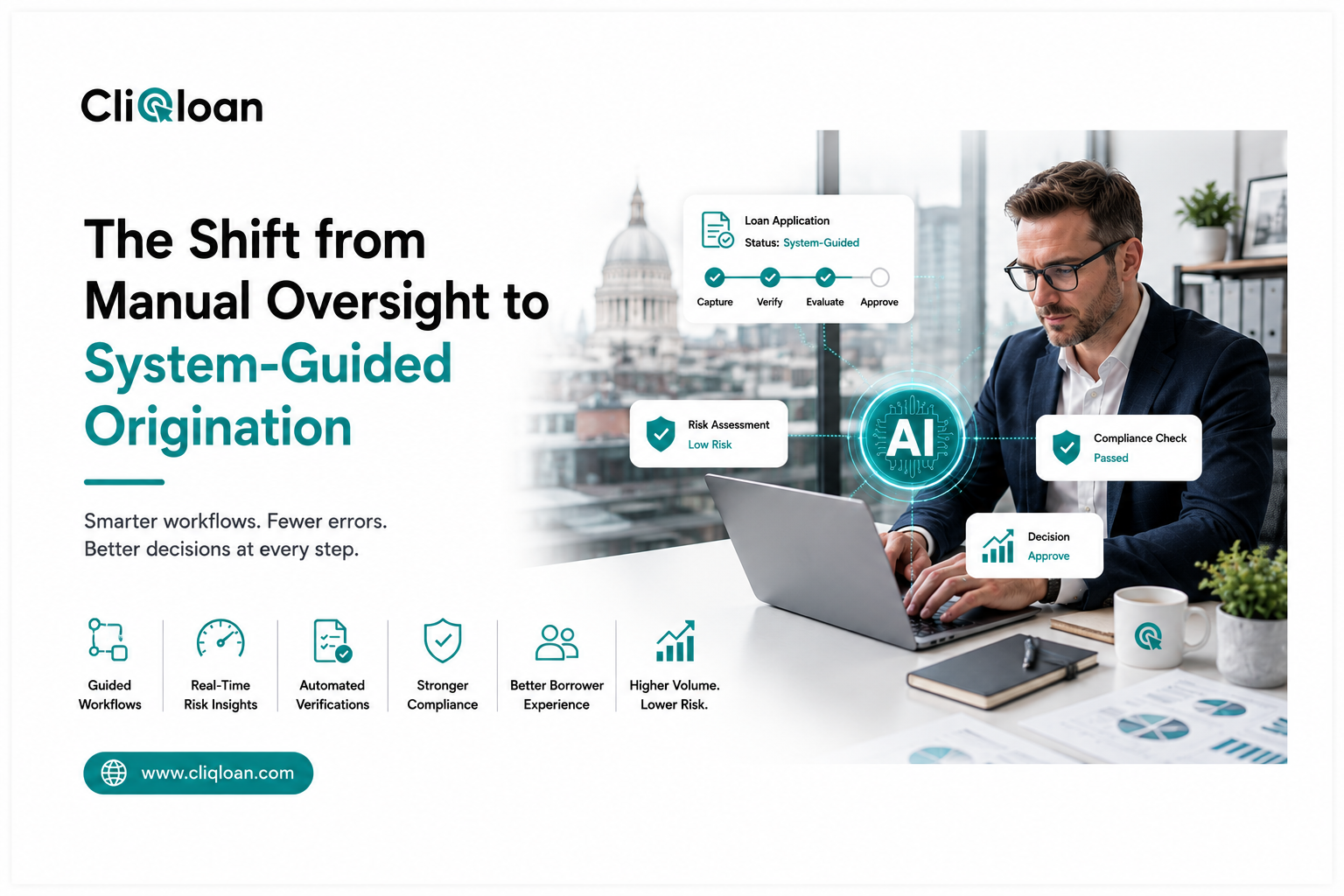
For decades, mortgage lending has relied heavily on manual oversight.
Loan officers chased paperwork through endless email threads. Processors manually reviewed income documents line by line. Underwriters worked through incomplete files while borrowers waited anxiously for updates. Every stage of the mortgage process depended on people remembering tasks, spotting inconsistencies, and coordinating across disconnected systems.
It worked — but barely.
Today, the mortgage industry is undergoing one of its biggest operational transformations in years: the shift from manual oversight to system-guided origination.
And it’s changing everything.
The Traditional Mortgage Workflow Was Never Built for Modern Lending
The traditional lending process was designed for a different era — one where paperwork moved slowly, compliance requirements were simpler, and borrowers were willing to wait weeks for updates.
But modern lending environments are far more demanding.
Borrowers now expect:
Digital-first experiences
Real-time updates
Faster approvals
Mobile accessibility
Secure online collaboration
At the same time, lenders are dealing with:
Rising compliance complexity
Margin pressure
Higher operational costs
Increased audit scrutiny
Distributed teams and remote workflows
Yet many organizations still rely on fragmented systems, spreadsheets, manual document reviews, and constant human intervention to move loans forward.
The result?
Delays, missed conditions, duplicate work, compliance risks, and frustrated borrowers.
Manual oversight is no longer scalable.
What Is System-Guided Origination?
System-guided origination replaces reactive, manual processes with intelligent workflows driven by automation, AI, and real-time collaboration.
Instead of employees manually tracking every task, modern platforms guide the entire loan lifecycle automatically.
The system itself becomes the operational framework.
For example:
Borrowers are automatically prompted for missing documents
AI validates uploaded files against borrower application data
Task workflows are triggered based on loan status
Compliance checks happen in real time
Stakeholders collaborate within a unified environment
Loan conditions are identified before underwriting delays occur
Rather than relying on human memory and fragmented communication, the process becomes structured, transparent, and data-driven.
This is not about replacing people.
It’s about enabling lending professionals to focus on higher-value decisions instead of administrative bottlenecks.
Why This Shift Matters Now
The timing is critical.
The mortgage industry is facing a perfect storm of operational pressure:
Shrinking profit margins
Increasing borrower expectations
Tighter regulatory oversight
Competitive fintech disruption
Growing demand for digital experiences
Lenders can no longer afford inefficient workflows that slow down closings and increase operational costs.
A single missing document or overlooked condition can delay funding, frustrate borrowers, and impact profitability.
System-guided origination addresses these issues directly by creating consistency across every loan file.
The biggest advantage is predictability.
When workflows are standardized and intelligently managed, teams gain visibility into every stage of the lending process.
That visibility improves speed, accuracy, accountability, and borrower confidence.
AI Is Becoming the Backbone of Mortgage Operations
Artificial intelligence is no longer a future concept in lending.
It is becoming the operational backbone of modern mortgage platforms.
AI-powered systems can now:
Verify documents against borrower data
Detect inconsistencies instantly
Reduce manual review time
Flag missing information automatically
Improve document accuracy
Support compliance readiness
Accelerate underwriting preparation
This dramatically reduces the repetitive manual work that has historically consumed mortgage operations teams.
More importantly, AI helps reduce one of the industry’s biggest hidden costs: rework.
When inaccurate or incomplete files move downstream, every department loses time correcting preventable errors.
System-guided platforms help stop these issues earlier in the process.
That creates measurable operational gains for lenders, brokers, and borrowers alike.
The Human Side of Digital Lending
One of the biggest misconceptions about automation is that it removes the human element from mortgage lending.
In reality, the opposite is happening.
When teams spend less time chasing documents and updating spreadsheets, they gain more time to build relationships, advise borrowers, and solve complex financial situations.
Borrowers still want trusted guidance during one of the biggest financial decisions of their lives.
But they also expect convenience.
The future of lending is not purely digital or purely human.
It’s a balanced combination of intelligent systems and personalized support.
The organizations that succeed will be the ones that combine operational automation with exceptional customer experience.
Collaboration Is the New Competitive Advantage
Modern origination is no longer confined to isolated departments.
Today’s lending ecosystem includes:
Borrowers
Loan officers
Mortgage brokers
Processors
Underwriters
Lenders
Investors
Compliance teams
When these stakeholders operate in disconnected systems, communication gaps become inevitable.
System-guided origination platforms solve this by creating centralized collaboration environments where every participant works from the same real-time information.
This reduces confusion, improves accountability, and accelerates decision-making.
Transparency is becoming a competitive advantage in mortgage lending.
Borrowers increasingly expect visibility into their loan progress instead of waiting days for status updates.
Platforms that provide secure messaging, task tracking, and real-time updates help create trust throughout the lending journey.
The Industry Is Moving Toward Intelligent Infrastructure
The future of mortgage lending will not be defined by who has the largest workforce.
It will be defined by who has the smartest infrastructure.
Lenders adopting intelligent origination systems are already seeing:
Faster loan processing
Reduced document errors
Improved compliance efficiency
Better borrower retention
Lower operational costs
Stronger scalability
The shift from manual oversight to system-guided origination is not simply a technology trend.
It is an operational transformation.
As digital lending continues to evolve, organizations that modernize their workflows today will be better positioned to compete tomorrow.
The mortgage experience is becoming faster, more transparent, and more intelligent.
And the companies leading this transition are redefining what modern lending looks like.