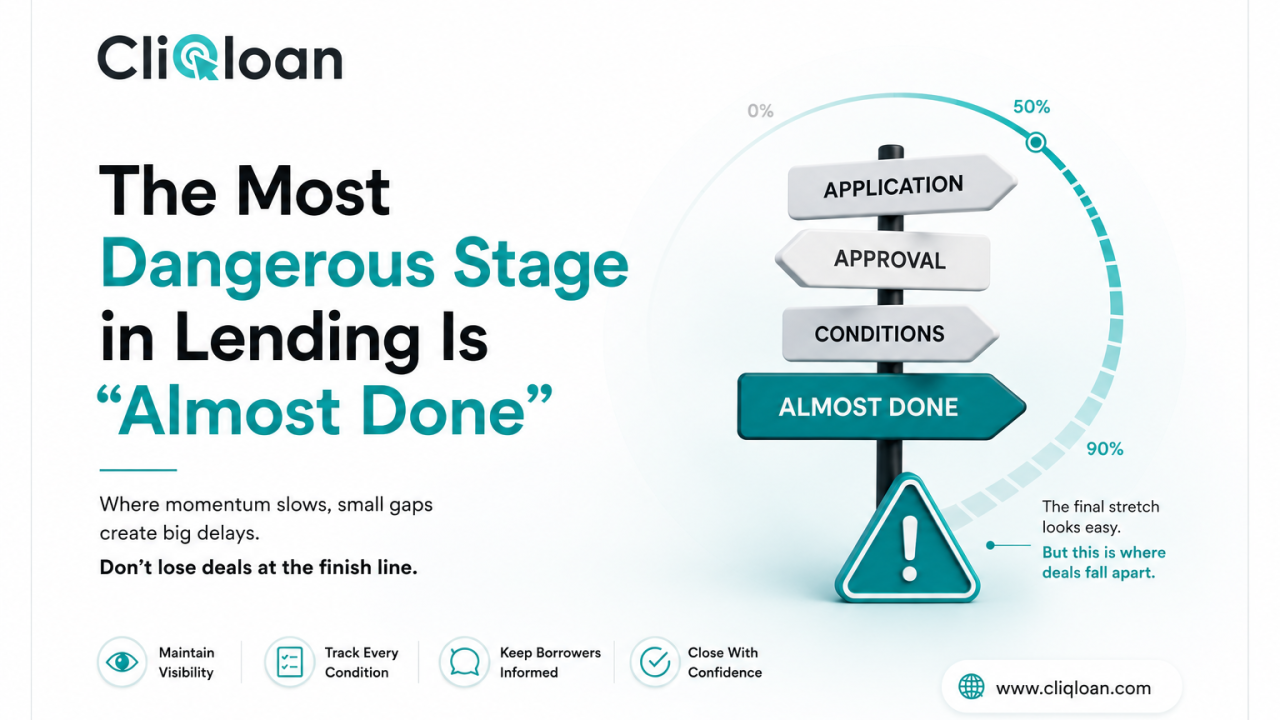
Most deals don’t fall apart at the beginning.
They fall apart when everyone thinks the hard part is over.
Right after:
approval
document collection
initial excitement
visible progress
That’s when the workflow quietly becomes dangerous.
Because in lending, “almost done” is often where momentum disappears.
The Illusion of Safety
Once a loan reaches the final stages, the assumption is simple:
“We’re basically there.”
The borrower relaxes. The team shifts attention to newer files. The urgency drops.
But behind the scenes, critical things are still moving:
pending conditions
final verifications
document updates
underwriting clarifications
coordination across stakeholders
And this is where delays begin compounding silently.
Why “Almost Done” Becomes Risky
At this stage, small issues feel harmless.
One missing signature. One outdated statement. One delayed response.
But lending workflows are deeply interconnected.
So one unresolved detail creates:
follow-up chains
stalled approvals
borrower uncertainty
operational confusion
And suddenly, a file that felt close to completion starts losing momentum.
The Real Problem Isn’t Complexity
The issue isn’t that lending is complicated.
The issue is that most workflows lose structure near the finish line.
Early stages usually have:
clear intake
defined urgency
active coordination
But later stages often become reactive.
Teams start relying on:
emails
manual reminders
status checks
memory
scattered communication
The process stops flowing automatically.
People start pushing it manually.
What Borrowers Feel During This Stage
For borrowers, “almost done” is emotionally important.
They expect clarity. Predictability. Confidence.
Instead, they often experience:
silence
unclear next steps
repeated requests
delayed updates
And confidence begins dropping.
Not because the loan is denied.
But because the process feels unstable.
Why Momentum Matters More Than Speed
Most lending conversations focus on speed.
Faster approvals. Faster underwriting. Faster closing timelines.
But speed alone doesn’t solve operational friction.
Momentum does.
Because a workflow with:
fewer interruptions
clearer visibility
structured communication
automated progression
will always outperform a workflow that constantly stops and recovers.
Modern Lending Needs Workflow Continuity
The future of lending is not just digital.
It’s continuous.
The process should not slow down near completion.
It should become even more structured.
That means:
condition tracking should stay visible
borrowers should know exactly what’s pending
workflows should move proactively
teams should spend less time chasing updates
The closer a deal gets to closing, the less friction it should create.
Not more.
Where CliQloan Fits In
At CliQloan, the focus isn’t just on starting workflows faster.
It’s about maintaining momentum all the way to closing.
Because operational visibility, automated flow, and structured communication matter most when deals are “almost done.”
That’s the stage where confidence is protected — or lost.
Final Thought
In lending, the most dangerous stage is not the beginning.
It’s the moment everyone assumes the work is finished.
Because “almost done” is exactly where workflows either:
move smoothly to closing
or
quietly begin falling apart.