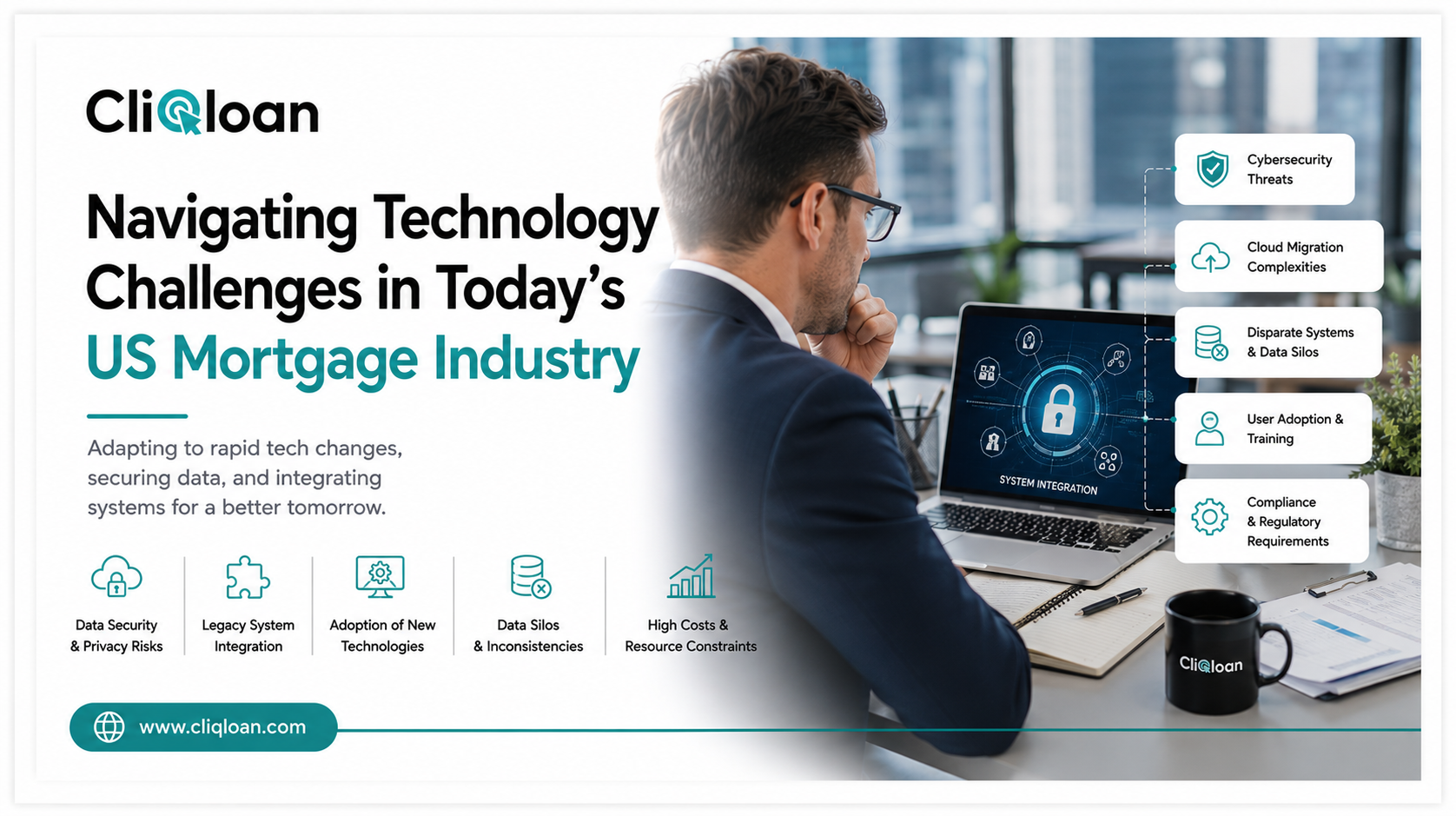
The mortgage industry in the United States has witnessed significant technological advancements in recent years. While technology has brought about various benefits and efficiencies, it has also introduced several challenges that the industry must address. Let us briefly look at some of these technical challenges and potential solutions possible for them.

1. Integrating Legacy Systems with Modern Technology
One of the foremost challenges faced by the US mortgage industry is the integration of legacy systems with modern technology. Many mortgage institutions still rely on outdated systems that lack interoperability. Integrating these legacy systems with new digital platforms can be complex and time-consuming. It requires extensive data mapping, system upgrades, and seamless integration to ensure a smooth transition. Overcoming this challenge requires strategic planning, sound investment in robust middleware solutions, and collaborative efforts between mortgage institutions and technology providers.

2. Ensuring Data Security and Privacy
The mortgage industry handles vast amounts of sensitive customer data, including personal and financial information. With the rise in cyber threats and data breaches, ensuring data security and privacy has become a critical challenge. Mortgage institutions must implement robust cybersecurity measures, including encryption, multi-factor authentication, and regular security audits. Additionally, compliance with regulations such as the Gramm-Leach-Bliley Act (GLBA) and the General Data Protection Regulation (GDPR) is essential. Continuous monitoring, employee training, and partnerships with cybersecurity experts are crucial to mitigating data security risks. There should be a continuous and conscious approach to ensure the best cyber measures at all times.

3. Enhancing Customer Experience
UI/UX is one of the biggest factors, if not the most important, for customers. Advancements in technology have significantly changed customer expectations in the mortgage industry. Borrowers now expect a seamless, digital experience throughout the mortgage process, from application to closing. However, many mortgage institutions struggle to deliver a user-friendly, end-to-end digital experience. Enhancing customer experience requires streamlining processes, leveraging automation and artificial intelligence (AI) tools, and providing self-service options. Implementing digital mortgage platforms, offering online document upload capabilities, and providing real-time updates to borrowers are key steps in meeting customer expectations.

4. Overcoming Regulatory Compliance Challenges
The mortgage industry operates under a complex web of regulations, including the Truth in Lending Act (TILA), Real Estate Settlement Procedures Act (RESPA), and the Home Mortgage Disclosure Act (HMDA), among others. Technological advancements often outpace regulatory guidelines, leading to compliance challenges. Mortgage institutions must invest in technology solutions that help automate compliance processes, ensure accurate reporting, and monitor changing regulatory requirements. Collaborating with legal and compliance experts and leveraging tools can aid in navigating the ever-evolving landscape of regulatory compliance.

5. Managing Data Integration and Quality
The mortgage process involves the integration and analysis of data from various sources, such as credit bureaus, appraisers, and title companies. Ensuring data integrity, accuracy, and consistency across systems is a significant challenge. Implementing robust data integration frameworks, employing data validation techniques, and leveraging data analytics tools can help manage this challenge effectively. Mortgage institutions should also focus on data governance practices, including data lineage and documentation, to maintain data quality and improve decision-making capabilities.

6. Adapting to the Changing Technology Landscape
The technology landscape is constantly evolving, with new innovations emerging regularly. Mortgage institutions must stay abreast of these changes and adapt accordingly. Keeping up with emerging technologies such as machine learning, artificial intelligence, and robotic process automation can provide significant advantages in terms of efficiency, risk management, and customer satisfaction. Collaboration with technology partners, participation in industry conferences and forums, and continuous education and training programs are essential to remain competitive and agile in the rapidly evolving mortgage industry.
The US mortgage industry faces several technology challenges that require proactive and strategic approaches. By addressing issues such as legacy system integration, data security, customer experience, regulatory compliance, data integration, and quality, and adapting to the changing technology landscape, mortgage institutions can position themselves for success in an increasingly digital and competitive landscape. Embracing technology as an enabler and investing in the right solutions will be crucial for the industry's growth and transformation.